

PHP continues to power a massive chunk of the web, and despite the rise of alternative backend languages, its ecosystem remains fiercely resilient, fast, and constantly evolving. As we navigate through 2026, modern web applications demand lightning-fast performance, robust security, scalability, and seamless API integrations. Writing raw procedural PHP for enterprise-grade or even mid-sized applications is no longer practical. This is where robust PHP frameworks step in to streamline development, enforce design patterns like MVC (Model-View-Controller), and save hundreds of development hours.
If you are planning a new web application or looking to upgrade your tech stack this year, choosing the right framework is the single most critical decision you will make. In this comprehensive guide, we will explore 10+ of the best PHP frameworks in 2026, examining why they excel in modern programming, along with their core pros and cons.
(Note: While updating our archives to bring you top-tier technical resources, you might also want to explore our guides on Top PHP Tools and Applications for Developers and core backend systems to optimize your workflow.)
Why Use a PHP Framework in Modern Programming?
Before diving into the list, it’s worth addressing why frameworks have become indispensable in professional software engineering:
# Reusability & Rapid Development: Instead of reinventing the wheel for authentication, database routing, and session management, frameworks provide pre-built modules and libraries.
# Strict Security Standards: Modern frameworks come out-of-the-box with built-in defenses against SQL injection, Cross-Site Scripting (XSS), Cross-Site Request Forgery (CSRF), and secure password hashing.
# Maintainability & Architecture: Frameworks enforce structured coding practices (like OOP and MVC), making it significantly easier for teams to collaborate on large codebases.
# Performance & PHP 8.x Optimization: Modern PHP versions (PHP 8.2, 8.3, and beyond) bring JIT compilation and native type hinting. Current frameworks are heavily optimized to leverage these core performance upgrades.
What Makes a Framework Superior in Modern Programming?
When evaluating why a specific PHP framework excels over plain PHP or competing frameworks in modern software engineering, developers look beyond simple syntax. In 2026, superior frameworks stand out through advanced architectural paradigms:
# Native Support for PHP 8.x Language Features: Modern frameworks fully harness Attributes, Readonly Classes, Enumerations, Named Arguments, and Constructor Property Promotion. This produces cleaner, strictly typed codebases with fewer runtime bugs.
# Inversion of Control (IoC) & Automatic Dependency Injection: Advanced frameworks manage class dependencies automatically through powerful IoC containers, making unit testing, mocking, and modular code decoupling effortless.
# Built-in Async & Asynchronous Non-Blocking I/O: With modern Fibers and Swoole/RoadRunner integrations, frameworks now handle high-concurrency WebSockets, real-time streaming, and background task queues directly inside PHP without blocking execution.
# First-Class REST & GraphQL API Generation: Modern frameworks offer native OpenAPI/Swagger generation, automated JSON serialization, and rate-limiting middleware, allowing backend teams to build microservice backends seamlessly.
# Automated Database Migrations & Type-Safe Query Builders: Instead of raw SQL queries, modern ORMs provide type-safe interfaces that eliminate SQL injection risks, keep database schemas in version control, and support seamless multi-database replication.
Top 10+ PHP Frameworks for 2026
1. Laravel
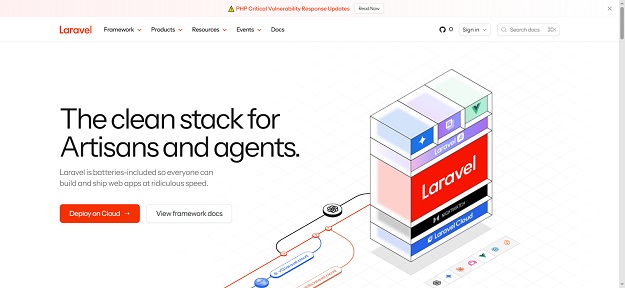
Laravel remains the absolute undisputed king of the PHP ecosystem. Known for its expressive, elegant syntax and developer-first philosophy, Laravel turns complex coding tasks—such as queue management, authentication, routing, and caching—into an absolute breeze.
Core Architectural Strengths
Laravel offers an unmatched ecosystem (Laravel Forge, Vapor, Livewire, Inertia.js) that bridges backend logic with modern frontend reactive frameworks seamlessly. It leverages dependency injection containers, queue workers with Redis/Amazon SQS out of the box, and real-time event broadcasting, cutting down development time exponentially.
Pros:
1. Incomparably rich documentation and a massive, active global community.
2. Robust built-in ORM (Eloquent) and powerful templating engine (Blade).
3. Exceptional package ecosystem via Composer and robust testing tools.
Cons:
1. Can feel a bit “heavy” or over-engineered for very small, trivial scripts.
2. Magic methods and extensive abstraction can sometimes obfuscate underlying performance bottlenecks.
2. Symfony
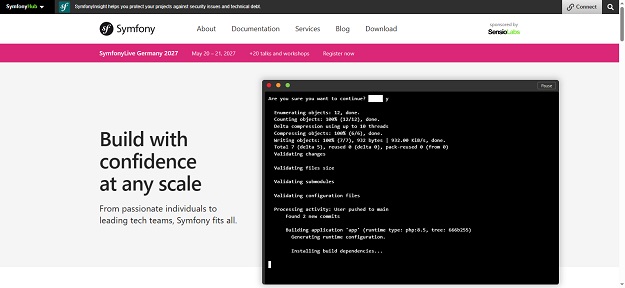
Symfony is the backbone of enterprise PHP development. Known for its stability, decoupled components, and strict adherence to PHP design standards, it powers massive platforms and large content management systems (like Drupal).
Core Architectural Strengths
Symfony’s reusable components are utilized by countless other projects (including Laravel itself). It excels in complex, highly scalable enterprise applications through its strict EventDispatcher system, DependencyInjection container, and Doctrine ORM integration, where long-term maintainability is mandatory.
Pros:
1. Highly modular and flexible architecture.
2. Unrivaled stability and backward compatibility.
3. Exceptional debugging tools (Symfony Profiler).
Cons:
1. Steep learning curve, particularly for junior developers or beginners.
2. Boilerplate setup can be time-consuming for smaller projects.
3. CodeIgniter
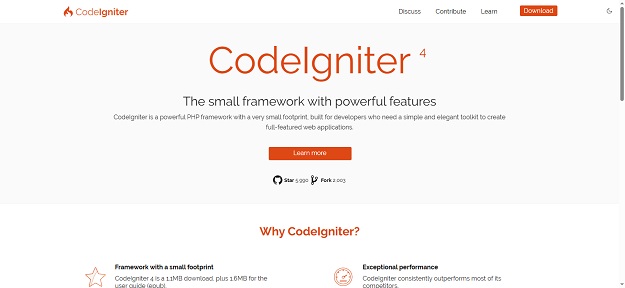
For developers who prioritize speed, a small footprint, and straightforward configuration over complex enterprise structures, CodeIgniter remains a beloved choice.
Core Architectural Strengths:
CodeIgniter requires nearly zero configuration and does not force strict adherence to coding rules, giving developers the freedom to build clean, lightweight applications without heavy overhead or memory allocation delays.
Pros:
1. Extremely fast performance and minimal resource consumption.
2. Simple, hassle-free installation and clear documentation.
3. Great for shared hosting environments with restricted configurations.
Cons:
1. Lacks some of the ultra-modern out-of-the-box features found in Laravel.
2. Community size is smaller compared to full-stack enterprise giants.
4. Yii (Yes, It Is)
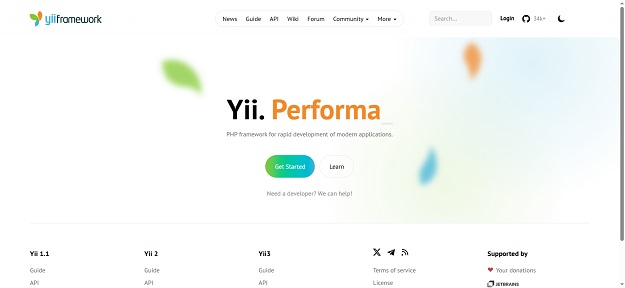
Yii is a high-performance, component-based PHP framework optimized for building large-scale web applications rapidly. It implements a strict DRY (Don’t Repeat Yourself) design pattern.
Core Architectural Strengths:
Yii features powerful caching support (Redis, Memcached, APC) and sophisticated AJAX-enabled features. Its lazy loading technique ensures components are only instantiated when requested, making it exceptionally well-suited for data-heavy web applications and single-page application (SPA) backends.
Pros:
1. Blazing fast execution speeds thanks to lazy loading techniques.
2. Advanced security measures, including robust input validation and SQL injection prevention.
3. Code generation tools like Gii drastically speed up scaffolding.
Cons:
1. Can be overly complex for simple CRUD apps.
2. Steeper learning curve for mastering its specific component lifecycle.
5. Phalcon
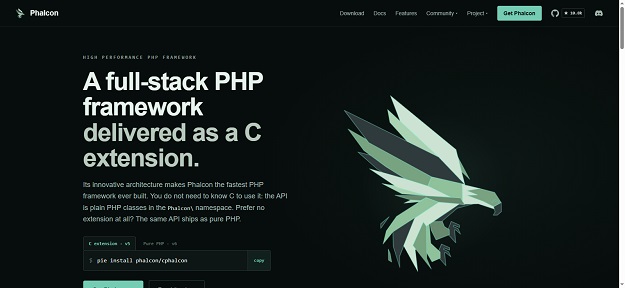
Phalcon is a revolutionary PHP framework implemented as a C-extension written in C/C++. Because it doesn’t rely on traditional file reads for every request, its performance metrics blow standard PHP frameworks out of the water.
Core Architectural Strengths:
It delivers maximum execution speed with minimal memory consumption by executing natively at the C-level, making it ideal for performance-critical systems, high-frequency trading dashboards, and IoT API backends where server resources must be conserved.
Pros:
1. Unmatched raw speed and low memory footprint.
2. Fully equipped with MVC, ORM, universal autoloading, and caching.
Cons:
1. Requires root/server-level access to install the C-extension, making deployment on cheap shared hosting tricky.
2. Smaller community and fewer third-party packages compared to Laravel or Symfony.
6. CakePHP
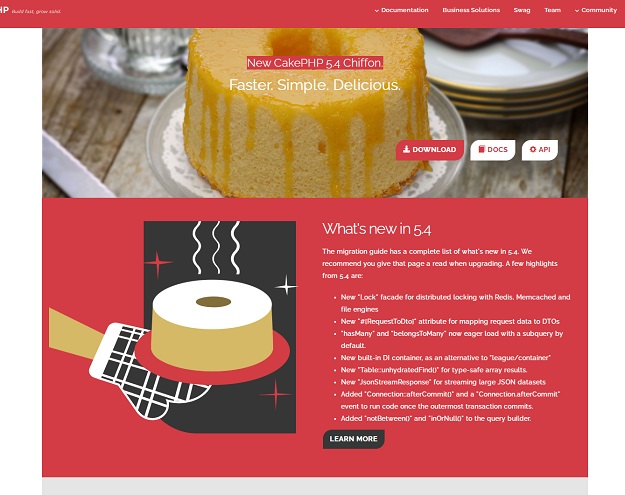
CakePHP has stood the test of time by continuously modernizing its core. It relies heavily on a “convention over configuration” paradigm, meaning developers write less configuration code.
Core Architectural Strengths:
It provides a solid, predictable structure with built-in validation, database access layer, and authentication guards. By following its file-naming conventions, you get automatically generated forms, CRUD operations, and strict MVC routing without manual configuration.
Pros:
1. Clean CRUD generation without writing boilerplate code.
2. Built-in security features (CSRF, form tampering protection).
3. Independent libraries that can be used separately.
Cons:
1. Less flexible due to strict adherence to its naming conventions.
2. Slower performance compared to micro-frameworks or C-extensions.
7. Slim Framework
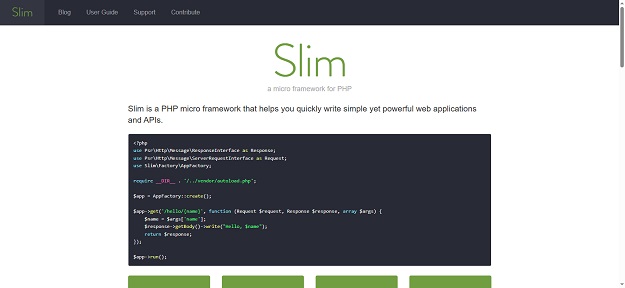
Slim is a minimalist micro-framework designed specifically for quickly building powerful RESTful APIs and small-to-medium web services.
Core Architectural Strengths:
When you don’t need a massive MVC stack and only want to route HTTP requests, handle PSR-7/PSR-11 middleware, and return clean JSON responses, Slim provides an agile, unbloated workspace with near-instant execution times.
Pros:
1. Ultra-lightweight with a minimal learning curve.
2. Highly extensible—you can plug in any ORM or template engine you prefer.
3. Perfect for modern microservices architecture.
Cons:
1. Lacks built-in UI components, authentication guards, or database managers out-of-the-box.
2. Requires manual assembly of external libraries for larger apps.
8. FuelPHP
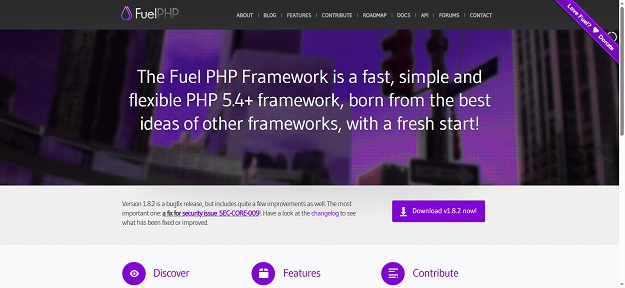
FuelPHP is a flexible, community-driven PHP framework that supports the HMVC (Hierarchical Model-View-Controller) pattern out of the box, offering superior modularity.
Core Architectural Strengths:
HMVC allows developers to build scalable widgets and modular application structures where controllers can request other controllers. This enables building completely independent sub-modules (like a shopping cart or comment system) that can be reused across different projects without code duplication.
Pros:
1. True modular architecture through HMVC support.
2. Strong URI routing system and robust input filtering security.
3. Lightweight and agile execution.
Cons:
1. Smaller community support base and fewer tutorial resources online.
2. Documentation can sometimes lag behind major version updates.
9. Laminas (formerly Zend Framework)
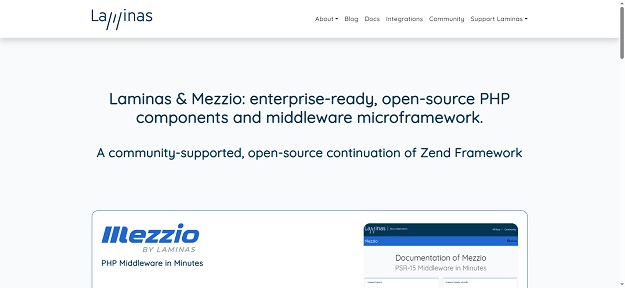
Laminas is a continuation of the legendary Zend Framework. It is a collection of professional, enterprise-grade object-oriented PHP packages.
Core Architectural Strengths:
Built for enterprise applications, Laminas focuses on high security, long-term stability, strict PSR compliance, and loose coupling, making it a favorite for large corporate infrastructures and financial institutions requiring rigorous auditing.
Pros:
1. Highly enterprise-compliant and secure.
2. Decoupled architecture allows using components independently as separate libraries.
Cons:
1. Overkill for startups or medium projects.
2. Configuration can feel verbose and cumbersome.
10. Flight PHP
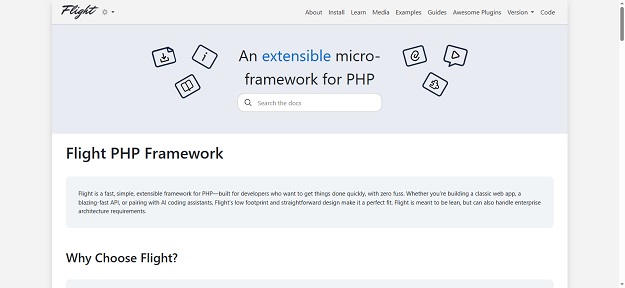
Flight is an extensible, fast micro-framework for PHP that enables you to quickly build RESTful web applications with absolute simplicity.
Core Architectural Strengths:
It allows developers to map URLs to callback functions directly, making small APIs, webhooks, and single-file routing scripts clean, readable, and extremely fast with virtually zero framework overhead.
Pros:
1. Extremely easy to understand and deploy in minutes.
2. Clean syntax with zero unnecessary bloat.
Cons:
1. Not suitable for large enterprise systems.
2. Very limited native ecosystem compared to Laravel or Symfony.
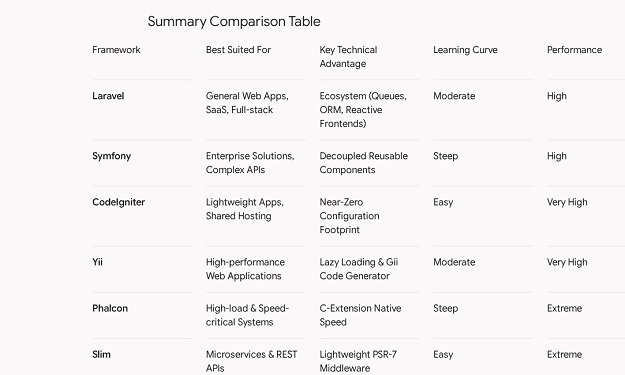
Summary Comparison Table
Conclusion: Which PHP Framework Should You Choose in 2026?
Choosing the right PHP framework ultimately boils down to your specific project requirements:
# If you want rapid development, rich packages, and a fantastic developer experience, go with Laravel.
# If you are building a massive enterprise-grade application that requires strict standards, choose Symfony.
# If your priority is speed, lightweight code, and simple APIs, look into Slim, CodeIgniter, or Phalcon.
Evaluate your project scope, team expertise, and long-term scalability needs before locking in your stack. Happy coding!


